Pocahontas’ uncle, the first suspected case of Myasthenia Gravis
In the 17th century, Opechancanough led devastating attacks on British settlers. Historical accounts on the powerful chief of the Powhatan Confederacy describe him as a feared warrior, but also mention a mysterious illness that left him exhausted and unable to lift his eyelids.
This is one of those moments when history and medicine collide to create a quirky anecdote.
In 1618, in present-day Virginia, the Powhatan nation was mourning its leader, the mighty Chief Powhatan. His passing came soon after his daughter’s, who was none other than Pocahontas.
Under his rule, Tsenacommacah, the historical homeland of the Powhatan people, had grown into a powerful political alliance and its territories were vast, extending across the Tidewater region.
Although Chief Powhatan had many children, none of them were to inherit his prestigious title of mamanatowick. The tribes of Tsenacommacah practiced a form of matrilineal inheritance. Hence, his succession as leader of the Powhatan Confederacy belonged to his siblings on the maternal side, his brothers coming first in line.
His younger brother, Opitchapam, officially succeeded him as paramount chief. But, “lame and decrepit” as per British colonists’ descriptions, he was eventually overshadowed by another one of them: Opechancanough.
Once a feared warrior – he had captured Captain John Smith a few years before –, Opechancanough had become more discreet and even feigned interest in Christianity, duping the English settlers into letting their guard down. On the morning of 22 March 1622, he launched a terrible assault on their settlements, killing more than 300 Englishmen in what was to be called the Indian Massacre of 1622. This gruesome event marked the beginning of more than twenty years of battles and wars.
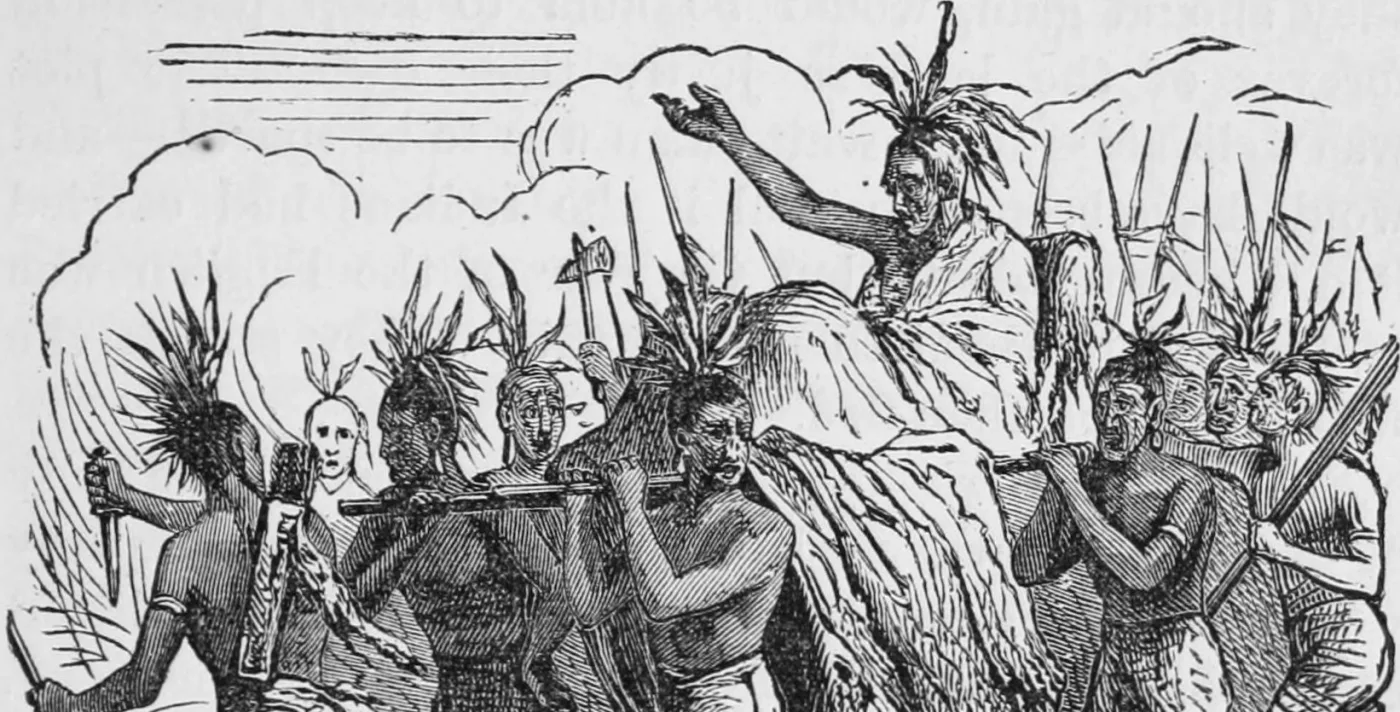
In those later years, Opechancanough had seemingly been struck down by some illness, an excessive fatigue rendering him unable to walk or even keep his eyes open. Historical accounts report that he “had to be carried on a litter before his warriors” and that “his eyelids were paralyzed so that he could only see when they were raised by his attendants.”
At the time, there was no word in the English language to describe the illness he was suffering from. In fact, no one would make a diagnosis of Opechancanough until… 1988. More than three centuries later, Dr. H. Blair Marsteller brought the Indian chief’s condition back to light, identifying it as “the first American case of myasthenia gravis”.
The first medical description of myasthenia gravis (MG) would only be made in 1672 by Thomas Willis, an Oxford physician and one of the founders of the Royal Society (no less!). Still, more than 200 years would pass before the illness was recognized as a distinct disease and finally named myasthenia gravis in 1895 by a German neurologist, Friedrich Jolly.
While we cannot be entirely sure that Opechancanough had myasthenia gravis, contemporary descriptions fit with MG’s symptoms: severe muscle weakness, drooping eyelids and difficulty performing everyday movements. Notably, Opechancanough’s state fluctuated and showed improvement with rest.
Despite his severe physical decline, the Powhatan leader lived into old age, continuing to defend his people’s territories before being fatally shot in the back by a settler while imprisoned.
Bleiben wir in Kontakt
Eine Frage oder Lust, uns zu unterstützen?